


Data Recovery from Mechanical Hard Drives
Let us help you get it back!
- Experts with +15 years of experience
- Recovers data within 4-7 business days
- +24,200 Analyses Performed
We recover your data from all types of Hard Drives
If your hard drive has failed, stopped booting, or simply disappeared from the system, don’t turn off hope before calling us.
At Laby we have been recovering data from mechanical hard drives (HDDs) of any brand for more than 12 years – Seagate, Western Digital, Toshiba, Samsung – and any interface: SATA, IDE, SCSI or SAS.
Whether the drive is making noise, has been bumped, the board has burned out, or it just won’t start, our technicians will evaluate the device in a cleanroom lab, give you a free diagnosis in less than 4 business hours, and a fixed price with no surprises. And if we don’t recover your data, we don’t get paid.
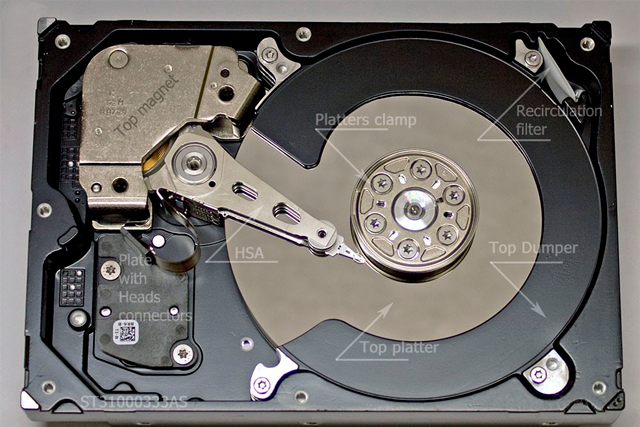
More than 33,500 devices in stock for fast and economical service. Own software and customized intranet.
Problems with your mechanical hard drive?
If you encounter any of these situations, don't continue using the device. The sooner you act, the more likely you are to recover your data.
-
The computer does not boot and warns of a hard drive failure.
-
The disc makes a strange noise (clicking, tapping) or goes very slowly.
-
After a power drop or power outage, the disc stops working.
-
The computer has crashed and the disk has broken or is not responding.
-
The computer boots up but does not recognize the hard drive.
-
You can't access saved videos, photos, or documents .
At Laby we are specialists in recovering hard drives
We work with any brand, model and type of interface. If your hard drive has failed, we will most likely be able to recover it.
Supported interface types
We work with all brands











How do we carry out recovery?
of data from mechanical hard drives?
A clear, transparent process with real-time tracking. No surprises in the price.
Inquiry
Tell us about your case. Immediate response from a specialist and a quote without obligation.
24/7 · 365 daysEvaluation
We analyze your hard drive and give you a diagnosis with the recovery viability, turnaround time and a fixed price.
Free diagnosisRecovery
Once the quote is approved, we act. Real-time tracking from your private portal.
95% success rateData Submission
Your data on an encrypted device sent to your door. Privacy guaranteed.
Shipping included when you accept the quoteHere are our deadlines
In just 1 hour
We process the collection by courier service from your home or company.
Within 4 working hours
After receiving the device in the laboratory (within 24 hours), we carry out a diagnosis and quote without obligation.
Between 4 and 7 working days
This is the average recovery time for the damaged device after the quote is accepted.*
What to do if you suspect that your mechanical hard drive has lost data?
-
1
Turn off your device as soon as possible. It will prevent further damage that may condition the recovery process. The heads of a moving mechanical disk can scratch the platters if there is an active fault.
-
2
Do not tamper with the device improperly. Forcing screws or opening it in an uncontrolled or dust-free environment can negatively affect the chances of recovery. The interior parts of an HDD are extremely sensitive and delicate.
-
3
Avoid using recovery software in cases of physical failure. If the disk makes noises or is not recognized, running recovery programs can permanently damage the heads or platters, leaving the device unrecoverable.
-
4
Contact a laboratory specialized in data recovery. They are the only professionals with the tools, the clean room and the appropriate training to evaluate and carry out the extraction processes with real guarantees.
Recovery Pricing
HDD Hard Drive Data
250€ – 450€
+ VAT
For logic or board faults
Problems accessing damaged partitions, bad sectors, or surface degradation. Electronic boards burned by short circuit, wrong voltages, or damaged components.
Contact350€ – 690€
+ VAT
For Firmware Breakdowns
SW of the corrupted disc. Damaged modules.
Contact450€ – 890€
+ VAT
For Engine Breakdowns
Over temperature or failure of the motor unit.
Contact450€ – 890€
+ VAT
For head failures
Surface degradation or failure of the reader unit.
ContactWhat determines the price
to recover your hard drive?
The cost depends on two key factors: the damage to the components and the man-hours required. At Laby we will never charge you more for the volume of data, only for the difficulty of access.
Component damage
Damaged heads, burnt electronic board, broken motor or degraded surface of the platters. The more serious the damage, the greater the technical complexity and intervention time.
Working hours
The difficulty of accessing the device marks the intervention time. Disks with SMR technology or with damaged firmware require much longer processes than conventional PMR or CMR models.
Albums until 2015 approx.
The reading unit was positioned in a specific sector and read or wrote directly. The flow was constant and the Translator module (responsible for translating physical information into logic) was hardly corrupted, which facilitates recovery.
Current disks — greater complexity
The tracks are smaller than the reader unit. The head must read a set of sectors, load it into a buffer, modify the values, and rewrite everything. This process creates major firmware issues and explains the wider price range on modern disks.
If we don't recover your data, we don't charge. The diagnosis is always free and the budget is without obligation. You only pay if we recover your information.
What do you think of us?
EXCELENTE A base de 597 reseñas
 Publicado en Google
 YroDUB
Trustindex verifica que la fuente original de la reseña sea Google.
Pese a que no se pudieron recuperar los datos por un fallo del disco, el servicio, la comunicación, el seguimiento y el trato han sido muy buenos. Muy recomendable.Publicado en Google Jordi VillalbaEs muy caro, carísimo, pero antes de alarmarse y entrar en pánico, hay que entender el porqué vale lo que vale. Hay que pagar a ingenieros cualificados que saben hacer este trabajo el cual es muy delicado. La sala donde se hace es una sala limpia con una ventilación especial para que no haya ni una mota de polvo, los ingenieros también van totalmente tapados para que ninguna mota de polvo enganchada en su piel quede en suspensión en la sala. Se siguen unos protocolos estrictos para que en la sala no haya ni una mota de polvo, ya que hasta una mota de polvo microscópica podría destruir datos del disco duro cuando éste está expuesto al exterior para trabajar con él. Todo este equipamiento y mantenimiento hay que pagarlo también, además de las piezas de respuesto para arreglar y recuperar los datos del disco duro. Es importante sopesar si uno necesita recuperar los datos de su disco duro, una vez asimilado el precio y dar el paso a querer recuperar los datos por su importancia, falta ver su profesionalidad. Aquí no fallan, buen trato, profesionalidad absoluta, consiguieron recuperar todos los datos del disco duro que llevé, es un sitio muy recomendable si se te ha roto por completo el disco duro, ni siquiera lo detecta el pc y necesitas recuperar los datos.Publicado en Google
 María del Carmen Benavente BaltasarMi disco duro sufrió una caída. Toda mi vida personal y profesional estaban en él. No podía acceder al contenido del mismo; parecía irrecuperable toda la información. Me quedé colapsada. Pedí a la IA alguna solución y me recomendó el envío a profesionales de recuperación de datos. El primero de la lista era LABY a quienes envié mi dispositivo. Ellos recuperaron todos los datos y me los enviaron en un nuevo dispositivo. ¡Me han salvado la vida!Publicado en Google
 Yaiza SánchezUna pasada. En menos de 10 días han recogido mi disco duro, han sacado todos los datos y me los han devuelto en un disco duro nuevo. Me habían dicho en otros sitios que era irrecuperable. Son muy profesionales, merece la pena cada euro pagado.Publicado en Google
 lino villegasEstaba desesperado porque el disco duro en el cual tenía guardado toda una vida familiar y que creía seguro ,resultó ser que después de un año sin usarlo ya no respondía , se me cayó el mundo encima, hasta que contacte con Laby, cuando me dieron el precio y condiciones me di cuenta que estaba en manos de profesionales, el precio es caro pero reconozco que el trabajo de Laby lo valía, y decirme quien no pagaría por recuperar unos recuerdos de personas que ya no están o de los hijos cuando eran pequeños, pues bien al final pudieron recuperar el 100% y estos súper agradecido a esta empresa de crecuperacion ,ah! se me olvidaba en la recepción hay dos chicas súper amables que si entras con alguna duda sales convencido de que tus recuerdos están en buenas manos, felicidades al equipo de Laby.Publicado en Google
 Ronken1984Han sido en todo momento cercanos y profesionales. Se me fastidió un disco duro de 4TB y han podido recuperarlo. No ha sido barato ( porque estas cosas no lo son ) pero si me han ofrecido un servicio excelente, con plena transparencia y confianza. Espero no volver a tener que pasar por esto, pero sin duda si la información es importante volvería con ellos. Muchas gracias por todo el servicio prestado.Publicado en Google
 Marina SanchezServicio excepcional, tanto técnica como humanamente. En un momento tan estresante como ver todos tus datos en riesgo, el equipo consiguió que me sintiera acompañada, entendida y en buenas manos desde el primer momento. Fueron siempre claros y transparentes con las expectativas, explicando el proceso con profesionalidad, pero sin perder nunca el trato cercano y humano. La recuperación técnica fue excelente, pero lo que realmente diferencia su servicio es la atención al cliente y la confianza que transmiten durante todo el proceso. Recomendaré su servicio a cualquiera que necesite recuperar datos. ¡Gracias por vuestro gran trabajo!Publicado en Google
 Susana GRecuperaron mis recuerdos cuando los daba por perdidos. Todo la informacion transparente y clara.Publicado en Google
 Amandine LouisEste laboratorio es, sin duda, el mejor en recuperación de datos. De principio a fin, mi experiencia ha sido fluida y sin complicaciones. Realmente los recomiendo. Son transparentes en todo, se comunican bien y ofrecen un servicio perfecto. Consiguieron recuperar todos mis datos perdidos, y les estoy muy agradecido. Tienen una gran experiencia y saben muy bien de lo que hablan.Publicado en Google
 Nil MatéHicieron una faena estupenda recuperándome datos de un disco duro que tenía hacía muchísimo tiempo, incluso cosas que había borrado hacía años que ni me acordaba que una vez estuvieran en el disco. Es caro, pero sin duda vale cada céntimo. Tu decides que precio tienen tus datos y lo importantes que son para ti. Yo lo tengo claro, si lo necesito para otro disco en algún momento, volveré a ellos. Profesionalidad, rapidez y amabilidad.
FAQs about Mechanical Hard Drive Data Recovery
What is a mechanical hard drive and how does it differ from other types of hard drives?
A mechanical hard drive is a magnetic storage device, composed of disks or platters that are usually made of aluminum or glass and read/write heads, to store and access data.
Unlike solid-state drives (SSDs) that have no moving parts, mechanical hard drives are more prone to mechanical failure caused by shock or vibration, sudden impact of the drive on the surface of the drives, and degradation and loss of magnetic properties of platter surfaces.
This makes it not uncommon for data to need to be recovered from a mechanical hard drive, as it is very easy for a hard drive to take a hit and fail some of the mechanical parts of the device.
In addition, in general terms they can be slower in terms of speed of access to data. However, they offer a large storage capacity at a relatively low cost, compared to SSDs.
What is the inner workings of a mechanical hard drive and how does it store data?
A mechanical hard drive consists of one or more magnetic disks or platters that rotate at high speed. Data is stored on disks via reader drives or read/write heads. They move quickly over the disks, reading and writing the information in the form of 0s and 1s.
Precise operation involves precise coordination between the movement of the discs and the heads to access the required information. The differences in speed between mechanical discs are determined in many cases by the rotational speed of the platters, the most common being 4200 RPM (revolutions per minute) to the fastest of 15000 RPM.
What are the main parts of a mechanical hard drive and what functions do they perform?
The main parts of a mechanical hard drive include the magnetic disks or platters that are usually made of glass or aluminum, the read/write heads or drives, the motor that spins the platters, and the electronic board, which contains the connection for power and data connectivity. Magnetic disks store the data, while read/write heads read and write the data to the disks.
The electronic board or PCB contains various chips such as the MCU (Main Controller Unit) which would be like the main processor in charge of managing all requests, the SPIN MOTOR which is the motor controller (responsible for starting, speed control and braking when it is turned off) and the MHA (reader unit controller).
Additionally, there is a ROM (a read-only chip) on the vast majority of boards that contains unique information for that disc, recorded at the time of manufacture of the disc. For this reason, among others, on modern disks, the boards cannot be exchanged without making certain specific modifications with appropriate hardware (tools) and knowledge.
My hard drive has fallen and is now making noise, does this mean it is damaged or broken?
If your hard drive has fallen and is now making noise such as clicking, buzzing, or repetitive knocking, it has likely suffered physical damage and you need to recover data from the hard drive.
The reader unit or heads are elements that are very sensitive to vibrations or sudden shocks. It is important to bear in mind that a fortuitous blow can cause the reader units to impact the surface of the discs or platters, marking them or even scratching the surface. After a sudden blow, if any abnormal sounds are heard, it is advisable to stop using the hard drive and seek professional help to assess the situation and determine if the information can be recovered.
If my hard drive has suffered a physical shock, is it possible to recover the information stored on it?
In the vast majority of cases, it is possible to recover information stored on a hard drive that has suffered a physical blow. However, successful recovery depends on the severity of the damage and the knowledge and means of the company performing this process. It is important to stop using the hard drive and not attempt to repair it on your own, as this can worsen the situation or even leave the device unrecoverable. The best option is to contact a professional data recovery laboratory that has experience in similar situations to assess the feasibility of retrieving the information. It is worth noting that it is not always possible to recover data in cases of severe physical damage.
Laby has a quality management system certified in accordance with the international standard ISO 9001:2015, ensuring efficient processes, continuous improvement and a high level of satisfaction in each project.

Laby is registered with the National Institute of Cybersecurity (INCIBE), reinforcing its commitment to best practices in cybersecurity, digital protection and information security.

Laby has an information security management system certified according to the international standard ISO/IEC 27001:2022, guaranteeing the confidentiality, integrity and availability of data.
If you want to know exactly the cost for you, the best thing to do is to contact us and we will give you a free quote without obligation.
What devices do we recover at Laby?
Mechanical Hard Disks
HDD disks have as main components the metal plates where data is stored, and the heads that access the information. The most common hard disk.
SSD Hard Drives
SSDs have no moving parts — hence "solid state." Information is stored in blocks with no heads required. Much more efficient and faster than HDD.
External Hard Drives
External hard disks let you store important backups outside your computer. A single failure can cause you to lose all that valuable data.
iPhone, iPad, iMac or MacBook
Apple devices including iPhone, iPad, iMac, MacBook and Mac Mini. Reliable, elegant and powerful — and fully recoverable when something goes wrong.
Laptop Hard Disks
Your laptop holds important work and personal data. If a failure occurs, all that valuable information can be at risk — we can get it back.
NAS, SAN and DAS Disks
A compact enclosure of several hard disks connected via network cable to the system. Commonly known as a network hard disk — we recover all configurations.
RAID Systems
RAID disks are a redundant group of independent disks (HDD or SSD) forming a storage system to distribute or replicate data across multiple drives.
Pen Drives and USB Flash Drives
Pen drives consist of one or more memory blocks using the same Flash technology as SSD devices, making them fast but vulnerable to sudden failures.
Memory Cards
Memory cards store data from cameras, phones and tablets. They vary in capacity and speed — and when they fail, we recover what matters most.
Virus or Ransomware
We recover data encrypted by viruses or ransomware. Ransomware blocks your device until a ransom is paid — depending on the type, it encrypts the full OS or specific files.
Mobile Phones and Tablets
Recovery from smartphones and tablets is carried out by analyzing the electronics of damaged components or through the chip-off process for deeper failures.
Data Deletion
We offer certified secure data erasure and destruction, carried out either in our laboratory or remotely, with full documentation for compliance and legal purposes.
Forensic Analysis
Computer forensic analysis and expert evidence. We recover and certify critical information with legal value, with certified experts for reports and legal proceedings.